For a trip to Taiwan, download Google Translate's offline Traditional Chinese dictionary before departure so you can read street signs and train boards without cellular reception. Use Pleco for precise single-character breakdowns and transit vocabulary. When speaking face to face at night market stalls, tea shops, or taxi stands, Clawmium Translate divides your screen into two facing halves so each person reads in their language, and automatically saves each session with an AI summary.
An international traveler in Taiwan encounters three main communication tasks: reading Traditional Chinese characters, riding urban transit and high-speed rail, and talking face to face with locals. Google Translate provides dependable offline dictionary packs and camera scanning that decode signs without mobile data. Naver Papago offers specialized Asian translation models designed for regional grammar. Pleco features deep character dictionaries with stroke order and radical breakdowns that work without cellular data for independent travelers.
Clawmium Translate specializes in two-way spoken conversations, placing an inverted display between two people and automatically saving dual-language transcripts with structured AI summaries. Mandarin Chinese is a tonal language where minor pitch differences change word meanings entirely, making spoken audio output and clear visual text particularly valuable. For mountain rail lines or underground subway corridors where mobile coverage drops, carrying a downloaded Google offline pack alongside our online conversation app provides reliable coverage without data worries.
The three translation challenges you face in Taiwan
Travelers exploring Taiwan encounter three specific language environments depending on where their route leads:
- Reading Traditional Chinese characters (繁體中文): Unlike mainland China which uses Simplified Chinese, Taiwan uses Traditional Chinese characters with intricate stroke structures. Generic translation tools trained exclusively on mainland data often produce clumsy phrases or fail to recognize regional vocabulary. In Taiwan, a hotel is commonly called a fàndiàn (飯店) rather than a jiǔdiàn (酒店), and a digital video is a yǐngpiān (影片) rather than a mainland shìpín (視頻).
- Four tones and local Taiwanese speech habits: Standard Mandarin in Taiwan features four tones plus a neutral tone. Taiwanese Mandarin sounds noticeably softer than northern mainland accents, frequently dropping retroflex tongue positions and adding expressive sentence-ending particles like la, ya, and o. For visitors, speaking into a live translation app that produces clean native audio and displays legible Traditional characters removes the anxiety of mispronounced tones.
- Navigating high-speed rail, metro networks, and mountain buses: Moving between cities involves the Taiwan High Speed Rail (THSR) along the western coast, conventional TRA trains along the eastern coast, and rapid transit systems in Taipei and Kaohsiung. While central stations feature bilingual English signage, provincial bus routes, scenic rail lines (such as the Pingxi and Alishan lines), and local taxi dispatchers operate almost entirely in Chinese.
Taiwan cultural etiquette: politeness, greetings, and courtesy
Before launching a translation tool in Taiwan, understanding local etiquette will make your daily interactions warm and productive. Taiwanese society is exceptionally welcoming to international visitors, and politeness is woven into every conversational exchange.
The single most helpful phrase to remember is "Bù hǎoyìsi" (不好意思). It literally translates to "embarrassed", but functions as the universal social phrase for "excuse me", "pardon me", "sorry to bother you", and "thank you for your service". Saying bù hǎoyìsi before asking for directions, ordering street food, or showing your phone screen instantly sets a respectful tone.
When handing your phone, credit card, or EasyCard to a store clerk, station attendant, or food stall vendor, use both hands whenever possible. Presenting objects with two hands signals mutual respect across Taiwanese culture. Greeting people with a gentle nod and a pleasant "Nǐ hǎo" (你好) before pointing to your phone ensures helpful cooperation.
Five translation apps for Taiwan, compared
These five apps cover the spectrum of travel requirements in Taiwan, from offline street navigation to live spoken conversations.
| App | Best For | MRT & Offline | Menu Scanning | Face-to-Face Mode | Key Constraint |
|---|---|---|---|---|---|
| Google Translate | Everyday multi-purpose travel | Select Pixel phones only | Live camera & photo translation | Face-to-face split screen | Discards full conversation history |
| Naver Papago | Asian language pairs & idioms | Text only (no voice offline) | Photo text translation | 1:1 conversation view | Limited to 14 languages |
| Pleco | Deep dictionary lookups & learning | Yes (complete offline database) | Live camera character lookup (paid) | No conversation mode | Dictionary lookups, not two-way dialogue |
| Apple Translate | Built-in quick iPhone lookups | Yes (downloadable pack) | Text & photo translation | Face to Face split view | Restricted to Apple hardware |
| Clawmium Translate (ours) | In-person dialogue with AI summaries | No (cellular data or Wi-Fi) | Camera photo translation | Two-way inverted split screen | Requires active internet connection |
Google Translate: the dependable offline baseline
Google Translate is an essential travel utility for any trip to Taiwan, providing dependable assistance without an internet connection when needed. Its greatest asset for travelers is its downloadable Traditional Chinese offline dictionary pack. Before heading out from your hotel Wi-Fi, download the Traditional Chinese pack to your device storage so you are never stranded without directions. This allows character and photo translations to work inside deep subway tunnels or mountain hiking trails where cellular reception drops.
Its live translate feature includes a split-screen conversation mode that shows translated text and plays spoken audio as each person speaks. We break down its interface and configuration in our guide to Google Translate's conversation mode.
The trade-off is that offline live speech translation is limited to Google's newer Pixel phones. On standard iPhones and non-Pixel Android devices, live spoken translation requires an active mobile data connection. Google Translate also does not save structured summaries or organize multi-turn conversations into reviewable transcripts.
Naver Papago: optimized for Asian travel
Developed by South Korea's search giant Naver, Papago is widely regarded as one of the sharpest translation engines for Asian language structures. It supports 14 languages, including Chinese (both Traditional and Simplified), English, Japanese, and Korean.
Papago handles Asian grammatical relationships and respectful registers cleanly, making it helpful for deciphering restaurant menus and regional announcements. Its 1:1 conversation mode lets you alternate speaking turns, and its photo feature scans signs reliably. However, Papago's offline capabilities are limited to text, and it does not automatically summarize extended conversations into structured notes.
Pleco: deep dictionary and character stroke lookups
Pleco is the gold standard Chinese language dictionary application used by expatriates, students, and frequent visitors to Taiwan. Unlike general automated translation tools, Pleco is engineered specifically for Chinese character analysis.
Pleco works entirely offline without requiring an active data connection. You can search characters by handwriting them on the screen, looking up radical components, or typing Pinyin or Bopomofo (Zhuyin). It provides detailed definitions, compound words, and example sentences. While Pleco is unmatched for understanding individual signs, station names, or unusual menu items, it is not built for continuous spoken conversation translation.
Apple Translate: built-in lookups for iPhone
For iPhone owners, Apple Translate comes pre-installed in iOS and integrates directly with Apple's on-device Neural Engine. Travelers can download offline language packs in settings, allowing two-way spoken conversation translation without cellular data.
Its Face to Face view rotates the top half of the screen 180 degrees so the person standing opposite reads Chinese right side up while you read English. The constraint is hardware lock-in: it cannot be installed on Android devices, and its vocabulary customization options for local Taiwanese phrasing are more limited than specialized tools.
Where Clawmium Translate fits
Clawmium Translate is our app, so evaluate this section with that context in mind. We developed Clawmium Translate specifically to remove the friction of face-to-face conversations between travelers and locals, running on both Android and iPhone.
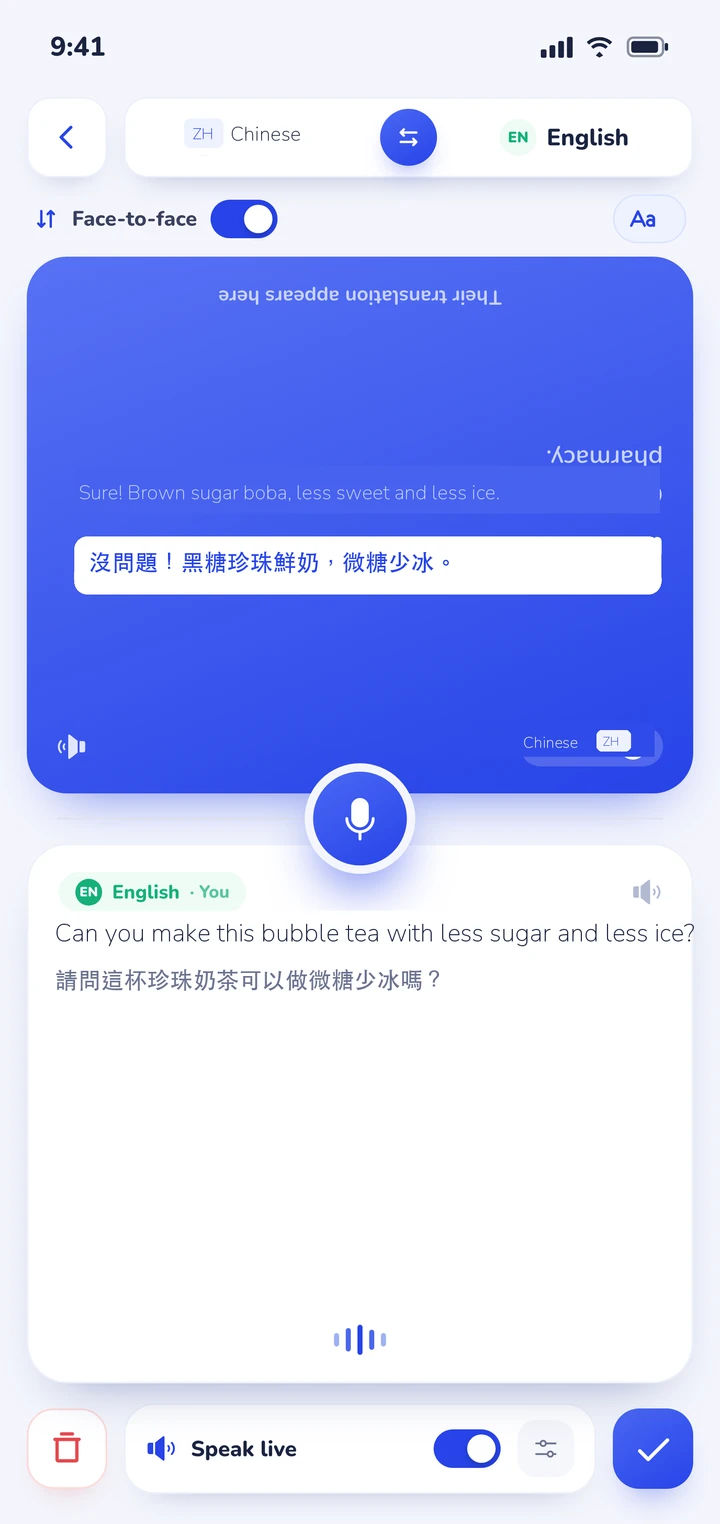
When you start conversation mode, the screen splits into two dedicated viewports. You place your smartphone flat on the counter at a Taipei night market stall, a ticket window at Taipei Main Station, or a rental car desk in Hualien. One half faces you, and the other half inverts so the local clerk reads along naturally in Traditional Chinese without needing to hold your personal device.
The app detects which of your two selected languages is being spoken automatically, eliminating the clumsy interruption of pushing buttons between every sentence. Spoken translations can also be read aloud through the speaker, with distinct natural voices assigned to each speaker.
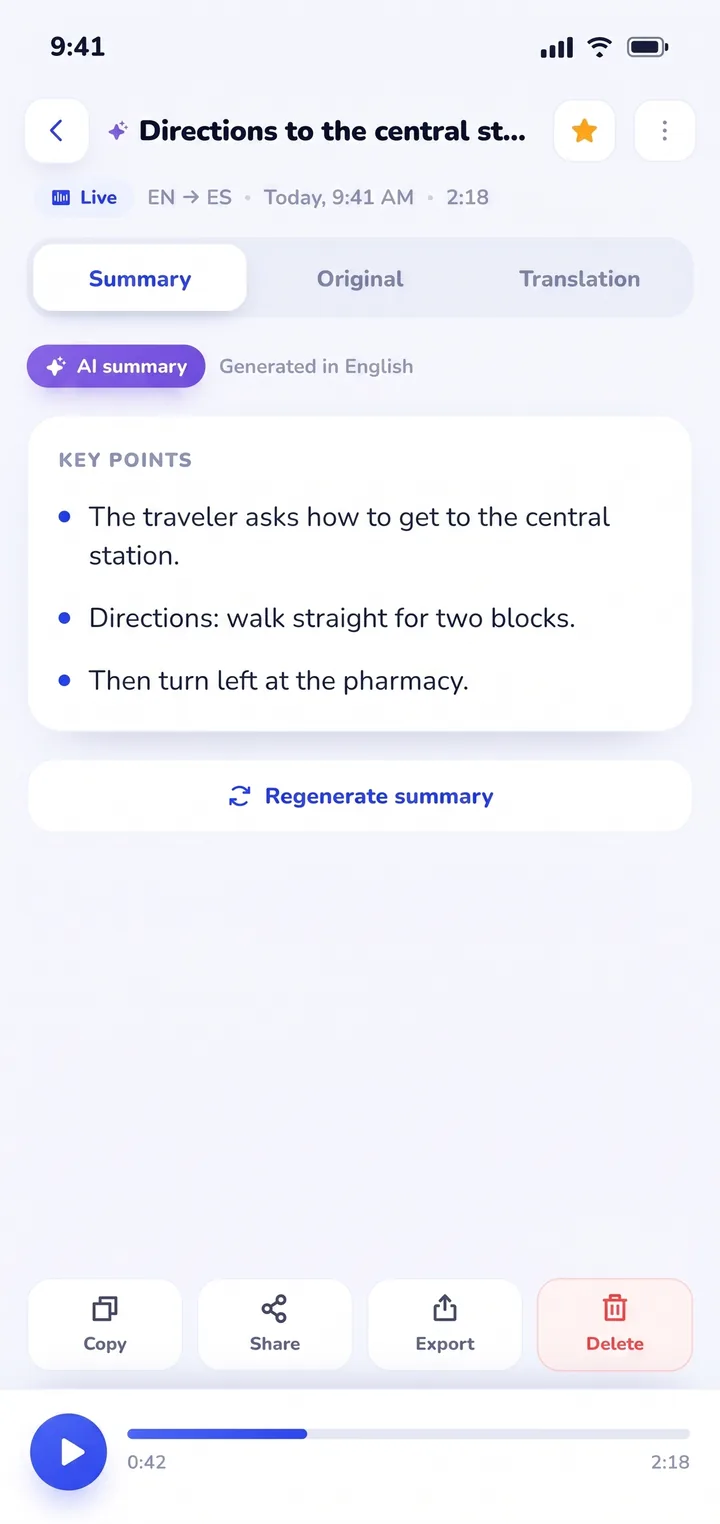
The most practical benefit for travelers in Taiwan is what happens after your conversation finishes. Every exchange is preserved in History on your device, complete with the dual-language transcript and an automated AI summary of key points. When a tea master explains brewing times and mountain varieties or a guesthouse host shares local hiking shortcuts, you do not need to scramble for notes. You open your saved History, review the summarized takeaways, and copy or share the details whenever needed.
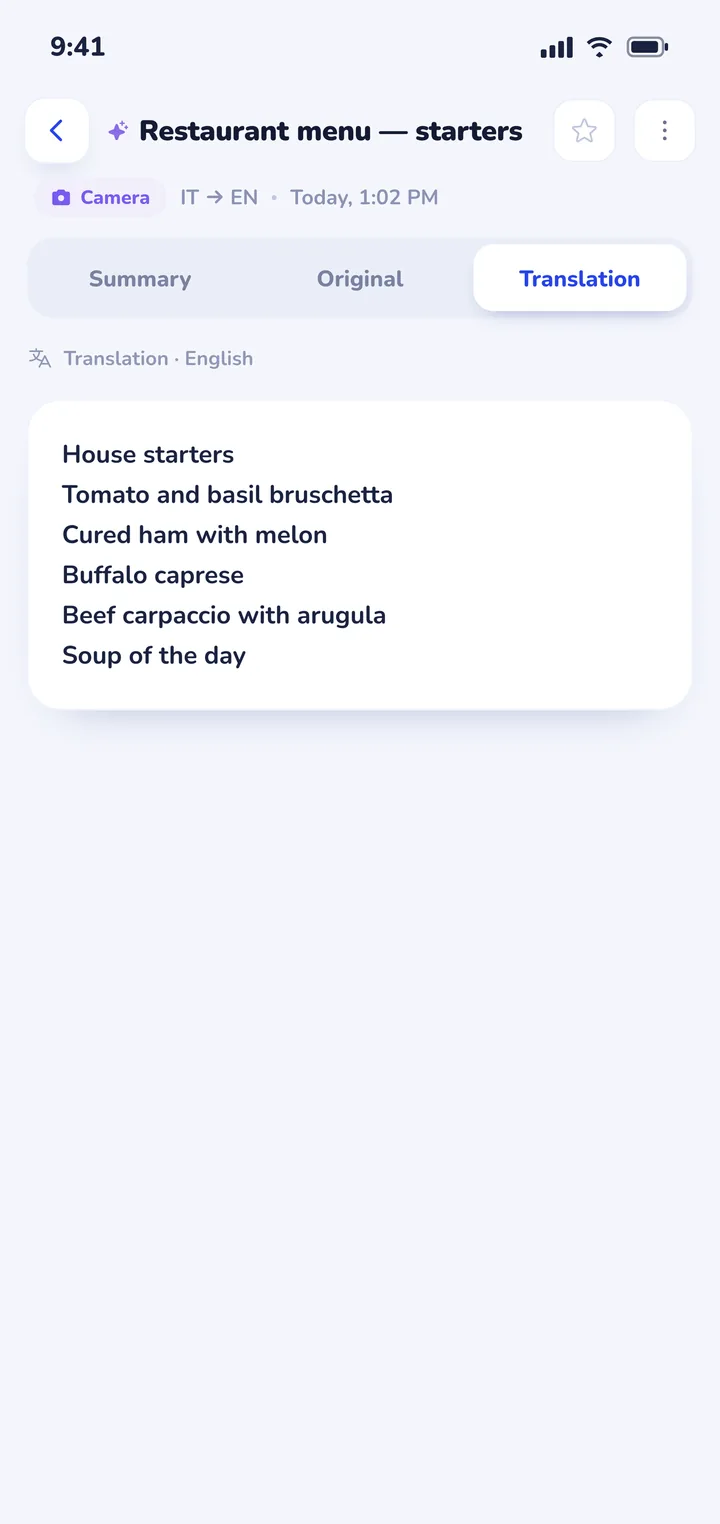
Clawmium Translate also includes a cloud camera translation feature that photographs printed restaurant menus, transit signs, and museum placards, overlaying readable English translations directly over the original image. For practical dining advice, read our guide on how to translate a menu with your camera. The app supports more than 60 languages, including Chinese, English, Japanese, Korean, Thai, Vietnamese, and European languages.
There are clear trade-offs to keep in mind. Clawmium Translate processes speech and camera translations through cloud models to maintain high linguistic accuracy, which means it requires an active Wi-Fi or cellular data connection. It does not offer an offline speech mode. It is free to download with a daily allowance for live translation that resets each day, and completely ad-free, with a Pro monthly tier that raises daily usage limits.
For remote mountain trails in Taroko Gorge or underground subway passages where cellular reception drops, Google Translate's downloaded offline pack remains the ideal backup tool to keep on your device. To see how spoken translation technology operates in other destinations, explore our travel guides to translator apps for Japan, translator apps for Korea, and translator apps for Thailand, or read our overview of real-time AI translator apps.


Navigating Taiwan night markets, street stalls, and boba tea shops
Eating in Taiwan is one of the world's great culinary adventures. From lively night markets like Shilin, Raohe, and Ningxia in Taipei to Fengjia in Taichung, ordering food involves unique customs:
- The bubble tea customization matrix: Taiwan is the birthplace of boba milk tea. Every tea shop requires you to choose sweetness (*tiándù* 甜度) and ice levels (*bīngliàng* 冰量). Sweetness choices are: regular sugar (全糖, 100%), less sweet (少糖, 70%), half sweet (半糖, 50%), slight sugar (微糖, 30%), and sugar-free (無糖, 0%). Ice options are: regular ice (正常冰), less ice (少冰), slight ice (微冰), and completely ice-free (去冰). Showing these exact terms on screen lets you order custom drinks clearly and accurately.
- Ordering classic Taiwanese street dishes: Street food stands specialize in beloved local items: braised pork rice (lǔròufàn 滷肉飯), oyster omelets (é-á-jiān 蚵仔煎), stinky tofu (chòudòufu 臭豆腐), beef noodle soup (niúròumián 牛肉麵), and pan-fried pork buns (shēngjiānbāo 生煎包). Pointing your phone camera at menu boards translates names and prices instantly.
- Dietary needs and vegetarian customs: Taiwan is one of the most vegetarian-friendly destinations in Asia. Look for the character Sù (素), meaning vegetarian food. Strict Buddhist vegetarian stalls display a swastika symbol (representing purity) and omit all meat, seafood, eggs, garlic, and onions. If you have an allergy, show written Chinese characters: wǒ duì huāshēng guòmǐn (我對花生過敏 = peanut allergy) or hǎixiān guòmǐn (海鮮過敏 = seafood allergy).
- Paper order slips (diǎn-cài-dān): Casual sit-down restaurants place a laminated paper menu slip (*diǎn-cài-dān* 點菜單) and a red marker on your table. You write your table number at the top, mark quantities beside each dish row, hand the slip to the counter, and pay either immediately or after eating. Using camera photo translation helps you decode the entire slip row by row.
Navigating Taiwan transit: Taipei Metro, High Speed Rail, and EasyCard
Getting around Taiwan is efficient and reliable, combining modern subways, bullet trains, and island-wide smart cards:
- Strict rules on the Taipei and Kaohsiung MRT: On both the Taipei Metro and Kaohsiung MRT, eating, drinking, sipping water, and chewing gum are strictly prohibited once you cross the bright yellow line at station gates. Violators face steep fines up to NT$7,500. Keep water bottles inside your daypack while riding trains.
- Taiwan High Speed Rail (THSR) vs. Conventional Trains (TRA): The THSR bullet train runs along the western corridor between Taipei and Kaohsiung (Zuoying) in just 90 minutes. The conventional TRA network loops around the entire island, including scenic eastern destinations like Yilan, Hualien, and Taitung. Both systems offer reserved seats and unreserved seating cars (zìyóuxí 自由席).
- EasyCard (Yōuyóukǎ) convenience: The contactless EasyCard (悠遊卡) is an indispensable travel asset. You tap it across the Taipei MRT, Kaohsiung MRT, city buses, conventional TRA trains, YouBike public bicycle stations, and convenience stores like 7-Eleven and FamilyMart. You can purchase and top up EasyCards with cash at any metro station or convenience store counter.
- Multi-country Asian travel: If your journey extends across East and Southeast Asia, compare options in our guide to translation apps for travel, or check our dedicated guides to translator apps for Japan, translator apps for Korea, and translator apps for Thailand.
Sources
- Taiwan Tourism Administration, Official travel and culture guide to Taiwan, checked 13 November 2026.
- Taipei Rapid Transit Corporation (TRTC), Taipei Metro route maps, safety regulations, and passenger guidelines, updated August 2025, checked 13 November 2026.
- Taiwan High Speed Rail Corporation (THSRC), High-speed train timetables, ticketing policies, and car classifications, updated September 2025, checked 13 November 2026.
- Google Help, Translate speech in Google Translate, updated 26 August 2025, checked 13 November 2026.
- Naver Papago, Papago neural machine translation features and languages, checked 13 November 2026.
- Pleco Software, Pleco Chinese dictionary application features and documentation, checked 13 November 2026.
Frequently asked questions
What is the best translator app for traveling in Taiwan?
Most travelers get the best results by carrying Google Translate for offline camera translation of Traditional Chinese signs and train boards, Pleco for offline character lookups, and Clawmium Translate for live spoken conversations with locals at night markets, tea shops, and guesthouses. Papago is also helpful for Asian phrase nuances.
Do I need to speak Mandarin when visiting Taiwan?
In central Taipei, major metro stations, and international hotels, staff speak conversational English. However, at night market food carts, traditional breakfast shops, provincial bus stops, and southern cities like Tainan, English is much less common. Carrying a live translation tool helps you order food and navigate transit smoothly.
Can translation apps read Traditional Chinese characters?
Yes. Modern neural optical recognition in Clawmium Translate, Google Translate, and Pleco can detect and separate Traditional Chinese characters, overlaying readable English translations directly over printed signs, food packaging, and restaurant menus.
Do translation apps work offline on the Taipei MRT and High Speed Rail?
In underground Taipei MRT tunnels and high-speed rail mountain tunnels, cellular signals can fluctuate. To maintain uninterrupted navigation access, download Google Translate's offline Traditional Chinese dictionary pack before entering transit networks.
Try a conversation before your trip to Taiwan
Free to start. 60+ languages. Put the phone between two people and talk.