For a trip to Italy, download Google Translate's offline Italian pack at home so you can read train departure boards and street signs without mobile data. Use DeepL for drafting polite written messages to hotel hosts and agriturismi, and use Apple Translate for quick offline spoken phrases on an iPhone. When speaking face to face with servers, taxi drivers, or shopkeepers, Clawmium Translate provides a two-way split screen and automatically logs every conversation with an AI summary.
An international traveler in Italy encounters three distinct language tasks: reading transit departures and printed restaurant menus, coordinating written reservations with agriturismi or private drivers, and speaking face to face with locals. In historic railway stations like Roma Termini or Milano Centrale where cellular signals drop between platforms, Google Translate or Apple Translate with a downloaded Italian offline pack provides dependable sign and announcement translations.
For written messages to boutique hotels or tour guides, DeepL produces refined phrasing that respects Italian formal etiquette. For spoken dialogue at wine bars, family-run trattorias, or taxi stands, passing a phone back and forth creates awkward delays. A split-screen conversation app placed flat on a cafe table lets both people read in real time in their own language. Because speech recognition streams audio to cloud models, travelers should secure an international European travel eSIM rather than relying on zero-data dictionaries alone.
The three language challenges of traveling in Italy
Italy is one of the world's most rewarding travel destinations, but language barriers frequently create friction outside five-star international hotels:
- Railway transit and regional strikes (Sciopero): Italy's rail network (Trenitalia and Italo) is fast and affordable, but train cancellations, platform changes (*binario*), and regional strikes (*sciopero*) are common. Announcements at regional stations are rarely spoken in English, and electronic departure boards update quickly. Downloading Google Translate's Italian language pack ahead of time helps you decipher platform monitors when cell service fluctuates.
- Regional trattorias and course structure: Italian menus are divided into distinct courses: *antipasti* (starters), *primi* (pastas and risottos), *secondi* (meat and fish), and *contorni* (side vegetables). Regional dialects mean a dish in Bologna has a completely different name in Palermo or Venice. Deciphering handwritten daily specials and understanding table charges like the *coperto* requires sharp optical recognition.
- Speaking with hosts and shopkeepers: Outside central tourist quarters, older shopkeepers, neighborhood market vendors, and countryside agriturismo hosts often speak little conversational English. Italian culture values warmth and eye contact; holding a live, natural conversation without awkwardly passing a phone across a counter makes interactions far more enjoyable.
Four translation apps for Italy, compared
Here's how the leading translation tools compare for an Italian holiday:
| App | Best for | Works offline | Price | Key consideration |
|---|---|---|---|---|
| Google Translate | Train station signs and offline transit backup | Yes (with downloaded pack) | Free | Download the Italian pack over home Wi-Fi before boarding your flight |
| Apple Translate | Quick offline spoken dialogue on iPhone | Yes (with downloaded pack) | Free (iOS only) | Clean split-screen view; limited to Apple devices |
| DeepL | Polite written inquiries to hosts and drivers | No (needs data) | Free tier available | Generates natural Italian grammar with proper formal registers (*Lei*) |
| Clawmium Translate | Spoken conversations and local recommendations | No (needs data) | Free daily allowance | Two-way split screen; automatically logs dual-language transcripts with AI summaries |
Google Translate: essential offline backup for trains and street signs
Google Translate is an indispensable travel utility because of its dependable offline features. Before your flight departs, download Google's Italian offline language pack onto your smartphone.
When you're standing inside the cavernous vaulted halls of Roma Termini or an underground metro station in Milan where cellular data drops, you can point your camera directly at printed departure schedules or platform track numbers to confirm your train. Google's live viewfinder overlay converts signage in real time without requiring data.
Apple Translate: built-in offline spoken dialogue on iPhone
If you travel with an iPhone, Apple Translate comes built into iOS and works offline. By downloading the Italian language pack within iOS Settings, you can translate typed text and spoken phrases without an internet connection.
Apple Translate features a clean face-to-face mode that divides your screen into two halves. While its vocabulary library is smaller than Google's and limited to Apple hardware, it offers a quick, private tool for basic spoken interactions when roaming data is turned off.
DeepL: the most natural Italian for written messages and reservations
DeepL is celebrated among linguists for generating exceptionally natural European language syntax. Italian grammar relies heavily on social formality, distinguishing between informal address (*tu*) and respectful address (*Lei*).
When you need to email a winery in Tuscany about a tasting reservation, message a boat captain on the Amalfi Coast, or explain a gluten allergy to a chef, DeepL produces phrasing that reads like a native speaker wrote it. It is primarily built for written text, making it an ideal companion for trip planning and correspondence.
Clawmium Translate: face-to-face dining and travel dialogue
Clawmium Translate is designed specifically for spoken conversations between two people who speak different languages. Instead of making you take turns tapping buttons or handing your personal device back and forth, the screen splits into two halves facing opposite directions.
You lay your phone flat on the trattoria table or hotel counter. The app automatically listens and detects whether someone is speaking English or Italian, displaying translated text on each person's side in real time. Crucially, every conversation is saved in History with an AI summary, so you never forget the name of a hidden bakery or a regional wine recommended by your server.
Trattorias, osterias, and enotecas: decoding Italian food menus
Dining is the highlight of any Italian trip, but menus can be confusing for first-time visitors:
- Understanding course sequencing: Italian meals are not served all at once. You don't have to order every course, but knowing that *primi* are carbohydrates (pasta, gnocchi, risotto) and *secondi* are proteins (veal, sea bass, bistecca) prevents ordering two huge main dishes by mistake.
- The *coperto* charge: Most traditional restaurants charge a small per-person fee (usually 2 to 4 euros) listed as *coperto*. This covers bread, tablecloth service, and place settings. It is a standard Italian dining practice, not a scam or tip.
- Translating chalkboard specials: Daily seasonal dishes written on chalkboards often feature local cuts of meat or regional vegetables not found in standard dictionaries. Pointing your camera at the board helps you decode ingredients before ordering.
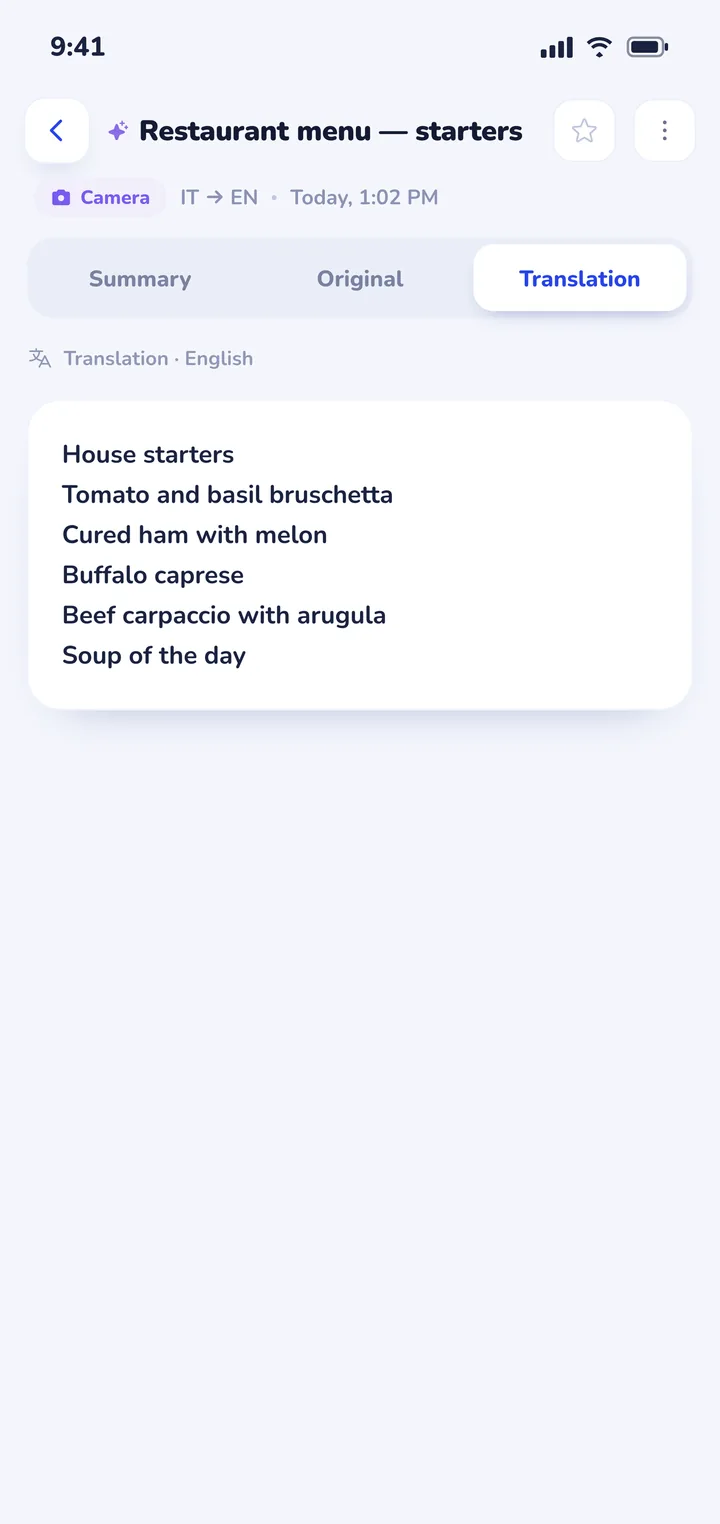
If you want a detailed walkthrough on framing and lighting when scanning menus in dim restaurants, read our practical guide to translating a menu with your camera.
Navigating Italian trains: Trenitalia, Italo, and rail etiquette
Italy's rail network is the easiest way to travel between major cities like Rome, Florence, Venice, and Milan, but small procedural details matter:
- Always check the train number, not just the destination: On station departure boards (*Partenze*), trains are listed by their final terminus, not intermediate stops. If you're traveling from Rome to Florence on a train terminating in Venice, look for your four-digit train number (e.g. Frecciarossa 9422) rather than the word "Firenze".
- Validating regional tickets: If you buy a paper regional train ticket from a kiosk, you must validate it in the small green or yellow stamping machines on the platform before boarding. High-speed tickets (Frecciarossa or Italo) with assigned seat numbers do not require stamping.
- Deciphering *sciopero* announcements: If you see the word *sciopero* on station displays or transport apps, a rail strike has been called. High-speed trains during peak commuter hours are legally guaranteed to run, but regional trains may be canceled. Use camera translation to read posted cancellation notices.
Where Clawmium Translate fits
Clawmium Translate is our app, so weigh this section with that context in mind. We make Clawmium Translate to give travelers a direct way to talk face to face with locals across different languages, running on both Android and iPhone.
In conversation mode, the screen divides into two facing sections. You place your phone flat on the counter at a wine bar or ticket desk. One side faces you, and the other side inverts so the person opposite reads along naturally in Italian without having to touch your phone.
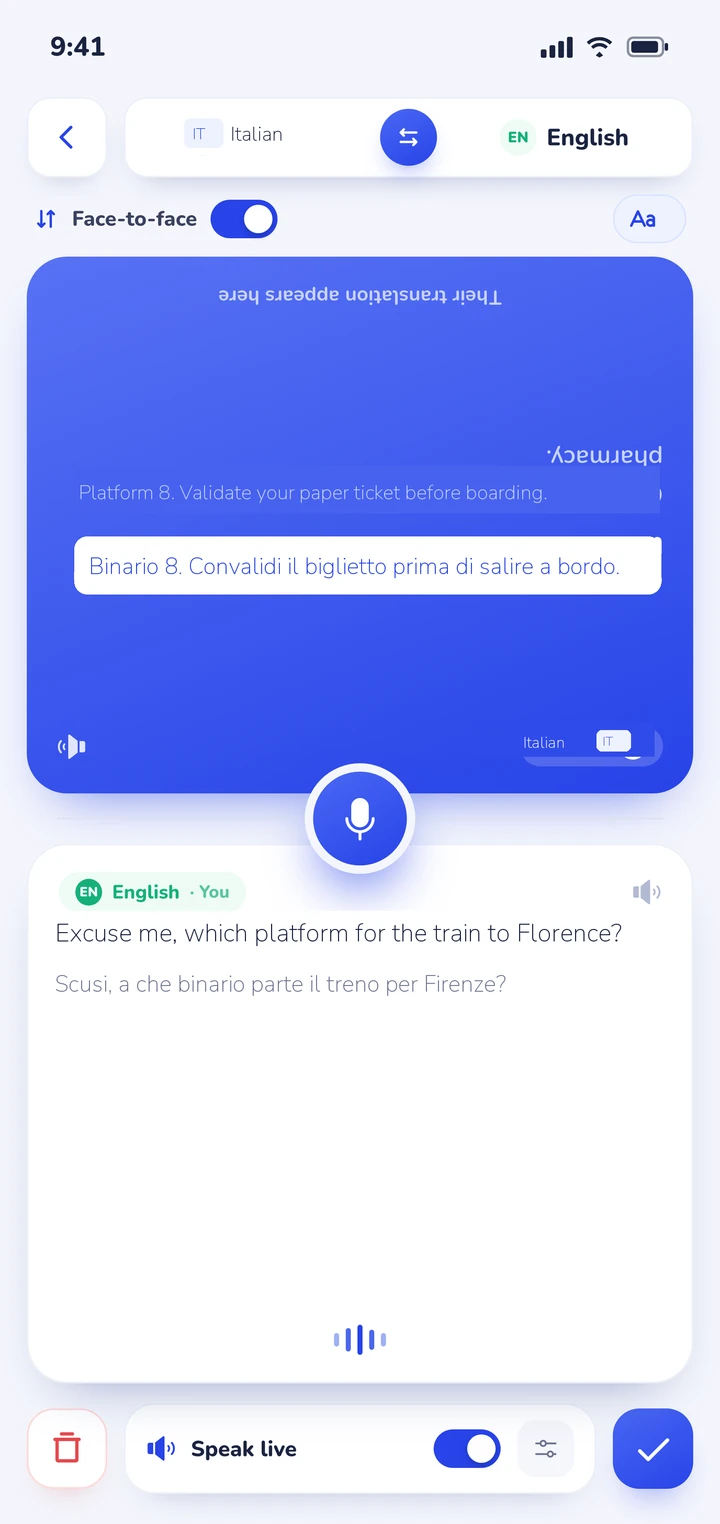
The app automatically detects which language is being spoken, eliminating the awkward friction of toggling buttons between sentences. Spoken translations can also be read aloud through the speaker, with distinct natural voices assigned to each speaker.
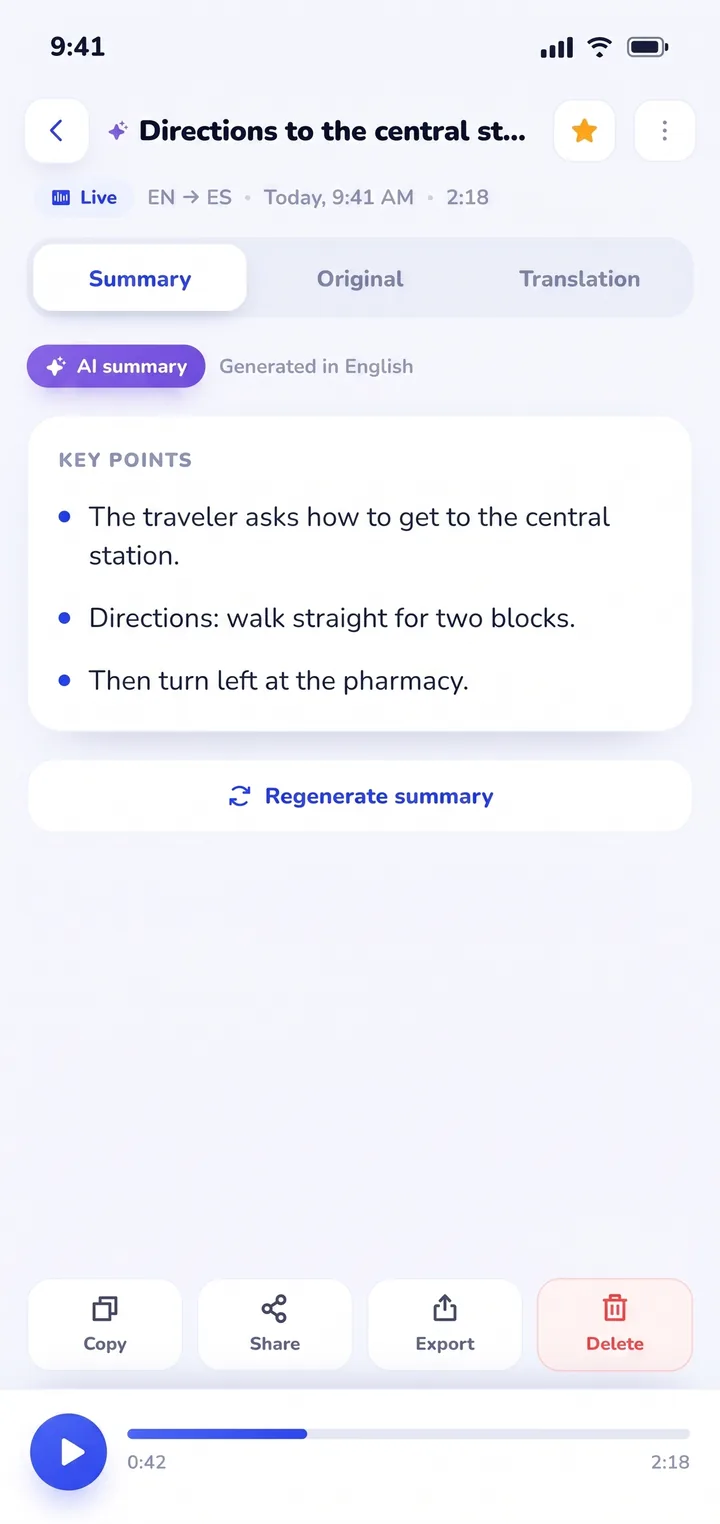
For travelers, the most practical advantage is what happens after the conversation ends. Every session is automatically stored in History on your phone, complete with the dual-language transcript and a concise AI summary of key points. When a friendly barista recommends three quiet hill towns or an agriturismo host explains driving directions, you don't need to scramble for a pen. You open History later and find the exact Italian names and instructions.
Clawmium Translate also includes camera translation that reads text from photos of printed signs and menus, plus document translation for saved PDF vouchers and booking confirmations. It supports more than 60 languages, including Italian, English, French, Spanish, German, Japanese, and Korean.
There are clear trade-offs to keep in mind. Clawmium Translate requires an active internet connection (cellular data or Wi-Fi) because speech and vision processing run through cloud models. It doesn't offer an offline speech mode. It's free to download with a daily allowance for live translation, completely ad-free, with a Pro monthly subscription that raises daily usage limits.
For underground railway passages where mobile signals drop, Google Translate's offline pack remains the ideal backup. If you're comparing spoken translation tools across platforms, read our guide on apps that translate in real time.


Italian conversation etiquette when using a translator
Using a translation app politely in Italy involves following a few simple cultural customs:
- Start with a greeting before speaking: Always open an interaction with a polite *Buongiorno* (good morning) or *Buonasera* (good evening) before placing your phone down or asking a question. Jumping straight into a translator without greeting staff is considered rude.
- Speak in clear, single thoughts: Long, rambling sentences confuse machine translation engines. Keep your phrasing direct and pause between sentences to let the translation process cleanly.
- Microphone placement: Lay the phone flat equidistant between you and your conversation partner on the counter or table. This ensures both voices are captured clearly, as explained in our guide on using a conversation translator face to face.
- Multi-country European travel: If your journey extends across Europe, compare options in our guides to translator apps for Germany and translator apps for France, or read our complete guide to translation apps for travel. If your travels include East Asian destinations, explore our dedicated guides to translator apps for Japan and translator apps for Korea.
Frequently asked questions
What is the best translator app for traveling in Italy?
Most travelers get the best results by carrying Google Translate for offline camera translation of street signs and train boards, and Clawmium Translate for live spoken conversations with locals at trattorias, markets, and hotels. DeepL is also great for drafting written messages to hosts.
Do I need internet for translation apps in Italy?
Basic text and camera translations can work offline if you download Italian language packs in Google Translate or Apple Translate before traveling. Spoken voice translation, however, streams audio to cloud models for accuracy and requires an active cellular connection. Getting an affordable European travel eSIM ensures reliable data everywhere.
Can Google Translate read Italian restaurant menus?
Yes. You can point your camera at a printed Italian menu using Google Translate or snap a photo in Clawmium Translate to see English descriptions overlaid on the text. If handwritten cursive script is difficult to read, toggle between languages or ask your waiter for clarification.
Is English widely spoken across Italy?
English is commonly understood at major tourist attractions, airports, and luxury hotels in Rome, Florence, and Venice. Outside central tourist zones, in smaller towns, and at local trattorias, English proficiency is limited, making a live translation app invaluable for daily interactions.
Sources
- Trenitalia Official Rail Information, Trenitalia passenger information and station guidelines, checked 8 November 2026.
- Google Translate Help, Translate offline on Android and iPhone, checked 8 November 2026.
- Apple Support, Translate text, voice, and conversations on iPhone, checked 8 November 2026.
- DeepL Support, DeepL mobile features and supported languages, checked 8 November 2026.
Try a conversation before your trip to Italy
Free to start. 60+ languages. Put the phone between two people and talk.