For a trip to Germany, download Google Translate's offline German pack before traveling so you can read train departure boards and street signs when cellular reception drops. Use DeepL for drafting polite written messages to hotel hosts or rental agencies. When speaking face to face at bakeries, market stalls, or ticket counters, Clawmium Translate divides your screen into two facing halves so each person reads in their language, and automatically saves each session with an AI summary.
An international traveler in Germany encounters three main communication tasks: deciphering compound German signs, riding regional rail networks, and speaking face to face with locals. Google Translate provides free speech translation across Android and iOS, with offline dictionaries that help in underground subway stations. Apple Translate offers on-device neural conversation mode for iPhone users traveling without mobile data. DeepL delivers the most natural German phrasing for written correspondence and accommodation messages.
Clawmium Translate specializes in two-way spoken conversations, placing an inverted display between two people and automatically saving dual-language transcripts with structured AI summaries. Germany has strict social conventions around formality and transit: platform numbers can change abruptly, while ordering at traditional bakeries moves rapidly. For rural travel where cellular reception drops without signal, carrying a downloaded Google offline dictionary alongside our online conversation app provides reliable coverage without data worries.
The three translation tasks you face in Germany
Travelers exploring Germany encounter three very different language environments depending on where their route leads:
- Deciphering compound printed words and cursive menus: German is famous for long compound words that combine multiple concepts into a single term (such as Schienenersatzverkehr for rail replacement bus service). Traditional beer halls in Munich, wine taverns in the Rhineland, and artisanal bakeries (Bäckereien) rarely offer English menus. Museum placards, pharmacy instructions, and supermarket allergen labels also require optical character recognition.
- Riding national rail and urban transit: Moving through major railway junctions like Frankfurt Hauptbahnhof, Berlin Hauptbahnhof, and Munich Hauptbahnhof involves automated ticket machines, platform changes (Gleiswechsel), and delay announcements (Verspätung). In underground U-Bahn stations, mobile signal frequently cuts out, making offline maps and downloaded language packs essential without internet access.
- Face-to-face spoken conversation: Ordering bread rolls (Brötchen) at early morning bakeries, buying Glühwein at seasonal Christmas markets, checking into countryside inns (Gasthöfe), or clarifying a missed connection with a train conductor requires quick two-way dialogue.
German travel etiquette and the formality rule: Du vs. Sie
Before launching a translation tool in Germany, understanding local communication customs will make your interactions much more productive. German culture values directness, punctuality, and mutual respect.
The most important rule in spoken German is the distinction between formal and informal address. German uses Sie for formal interactions with adults you don't know, officials, doctors, train conductors, and shopkeepers. The informal pronoun du is reserved strictly for family, close friends, children, and fellow university students. A translation app should default to formal address so you don't accidentally sound disrespectful.
Always open interactions with a polite greeting before showing your smartphone screen. A simple "Guten Tag" (good day) or "Entschuldigung" (excuse me) establishes polite intent. Walking up to a counter and thrusting a phone into someone's face without greeting them first is viewed as impolite.
Five translation apps for Germany, compared
These five apps cover the spectrum of travel requirements in Germany, from offline subway navigation to live spoken conversations.
| App | Best For | U-Bahn & Offline | Menu Scanning | Face-to-Face Mode | Key Constraint |
|---|---|---|---|---|---|
| Google Translate | Everyday multi-purpose travel | Select Pixel phones only | Live camera & photo translation | Face-to-face split screen | Discards full conversation history |
| Apple Translate | Offline conversation on iPhone | Yes (with downloaded pack) | Text & photo translation | Face to Face split view | Restricted to Apple hardware |
| DeepL | Polite written messages & emails | No (requires internet connection) | Document & photo translation | Single continuous list | Lacks split-screen conversation UI |
| Microsoft Translator | Multi-language offline fallback | Yes (downloadable language pack) | Camera photo translation | Split-screen microphone mode | Speech recognition slower on compound nouns |
| Clawmium Translate (ours) | In-person dialogue with AI summaries | No (cellular data or Wi-Fi) | Camera photo translation | Two-way inverted split screen | Requires active internet connection |
Google Translate: the dependable offline baseline
Google Translate is an essential travel utility for any trip to Germany, providing dependable assistance without an internet connection when needed. Its greatest asset for travelers is the depth of its offline German language pack. Before you leave home or from your hotel Wi-Fi, download the German offline dictionary to your phone storage so you're not caught without directions. This allows text and photo translations to work inside deep subway tunnels where cellular reception drops.
Its live translate feature includes a split-screen conversation mode that shows translated text and plays spoken audio as each person speaks. We break down its interface and configuration in our guide to Google Translate's conversation mode.
The trade-off is that offline live speech translation is limited to Google's newer Pixel phones. On standard iPhones and non-Pixel Android devices, live spoken translation requires an active mobile data connection. Google Translate also doesn't save structured summaries or organize multi-turn conversations into reviewable transcripts.
Apple Translate: built-in offline spoken dialogue for iPhone
For travelers carrying an iPhone, Apple Translate comes pre-installed in iOS and runs on Apple's on-device Neural Engine. Travelers can download the German offline language pack in settings, enabling two-way spoken conversation translation without cellular data or Wi-Fi.
Its Face to Face view rotates the top half of the screen 180 degrees so the person standing opposite reads German right side up while you read English. On devices running iOS 26 with Apple Intelligence, Apple also integrates real-time translation into Phone calls and Messages. The constraint is hardware lock-in: it can't be installed on Android devices, and its vocabulary library is smaller than Google's.
DeepL: the German gold standard for grammar
Headquartered in Cologne, Germany, DeepL was developed by European researchers and is widely recognized as a leading machine translation engine for the German language. German grammar presents notorious hurdles for translation models, including four grammatical cases (nominative, accusative, dative, genitive), split verbs, and subtle modal particles (like doch, mal, and ja). DeepL handles these sentence structures with unmatched fluency.
If you're writing an email to a German guesthouse, composing a message to a landlord, or reading a complex legal ticket rule, DeepL produces flawless phrasing. However, DeepL isn't designed as a live conversation tool: it lacks an inverted split-screen interface, and it operates exclusively through cloud servers, requiring an active internet connection.
Microsoft Translator: versatile multi-language fallback
Microsoft Translator offers downloadable offline language packs for German and supports split-screen spoken dialogue. It provides clean text translation and photo scanning capabilities.
While practical for general travel queries, its speech recognition can struggle with long German compound words and regional southern accents (such as Bavarian or Swabian). It also lacks automated post-conversation summarization.
Where Clawmium Translate fits
Clawmium Translate is our app, so evaluate this section with that context in mind. We developed Clawmium Translate specifically to remove the friction of face-to-face conversations between travelers and locals, running on both Android and iPhone.
When you start conversation mode, the screen splits into two dedicated viewports. You place your smartphone flat on the counter at a bakery in Berlin, a ticket window at Frankfurt Hauptbahnhof, or a market stall in Nuremberg. One half faces you, and the other half inverts so the local speaker reads along naturally in German without needing to hold your personal device.
The app detects which of your two selected languages is being spoken automatically, eliminating the clumsy interruption of pushing buttons between every sentence. Translations can also be read aloud through the speaker, with distinct natural voices assigned to each speaker.
The most practical benefit for travelers in Germany is what happens after your conversation finishes. Every exchange is preserved in History on your device, complete with the dual-language transcript and an automated AI summary of key points. When a train conductor explains a complicated platform transfer due to track maintenance or a friendly server recommends three regional wines in the Mosel valley, you don't need to scramble for notes. You open your saved History, review the summarized takeaways, and copy or share the details whenever needed.
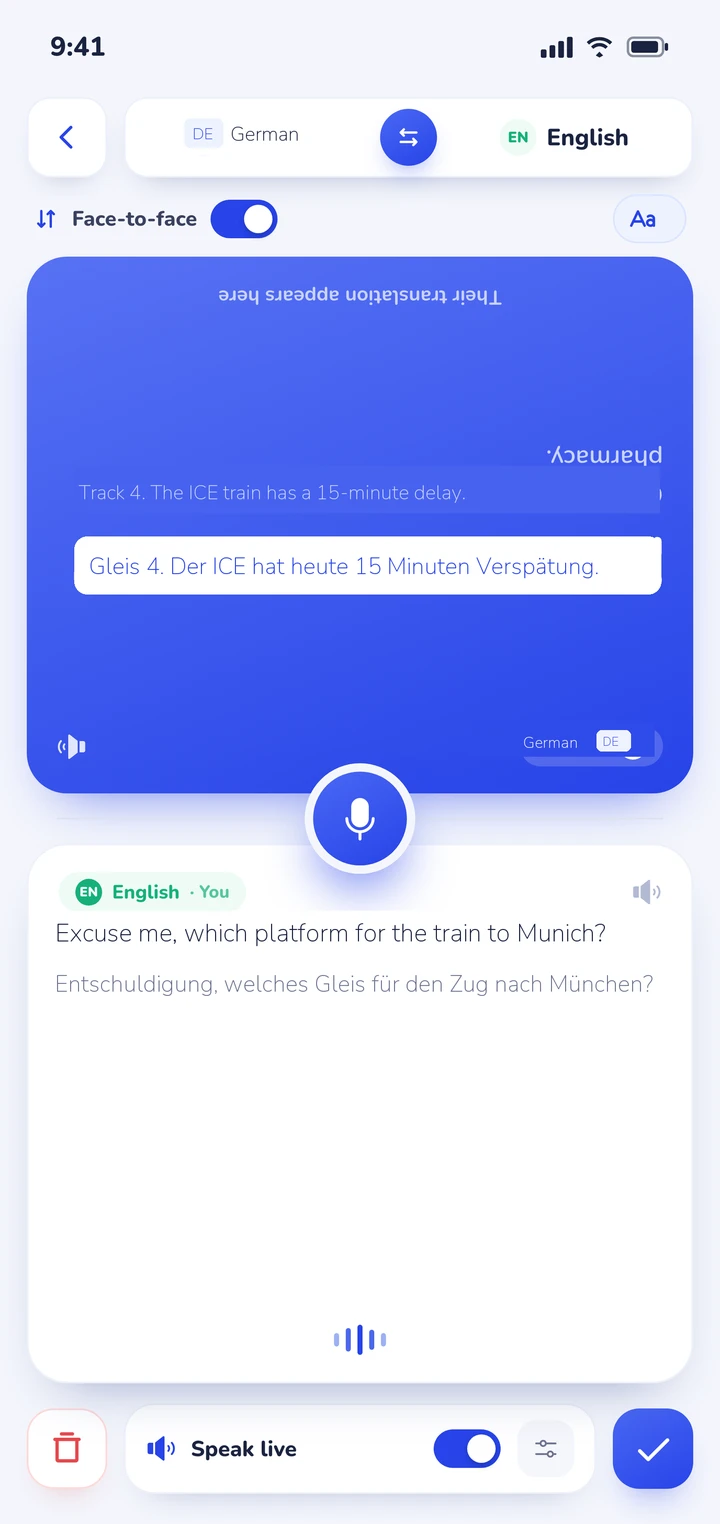
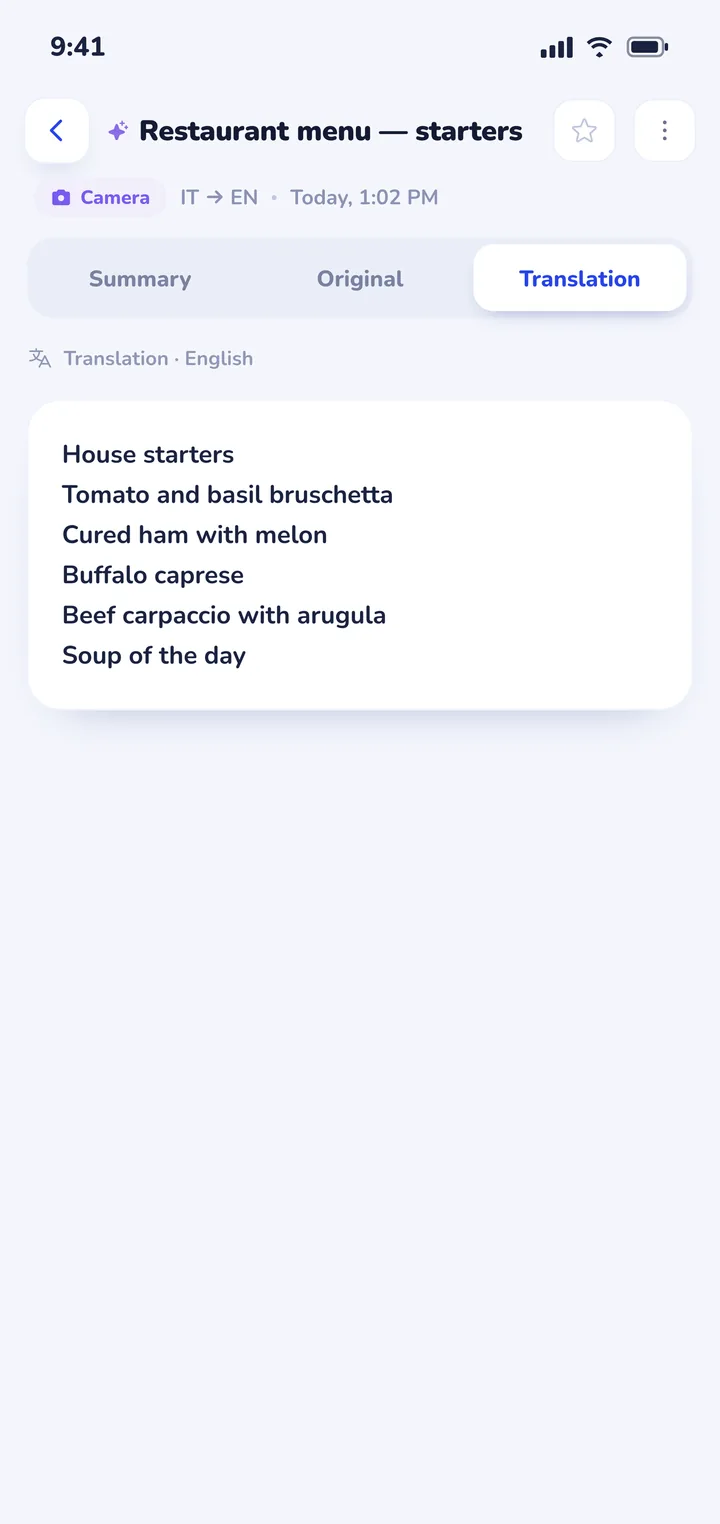
Clawmium Translate also includes a cloud camera translation feature that photographs printed restaurant menus, transit signs, and museum placards, overlaying readable English translations directly over the original image. For practical dining advice, read our guide on how to translate a menu with your camera. The app supports more than 60 languages, including German, English, French, Spanish, Italian, Japanese, Korean, and Arabic.
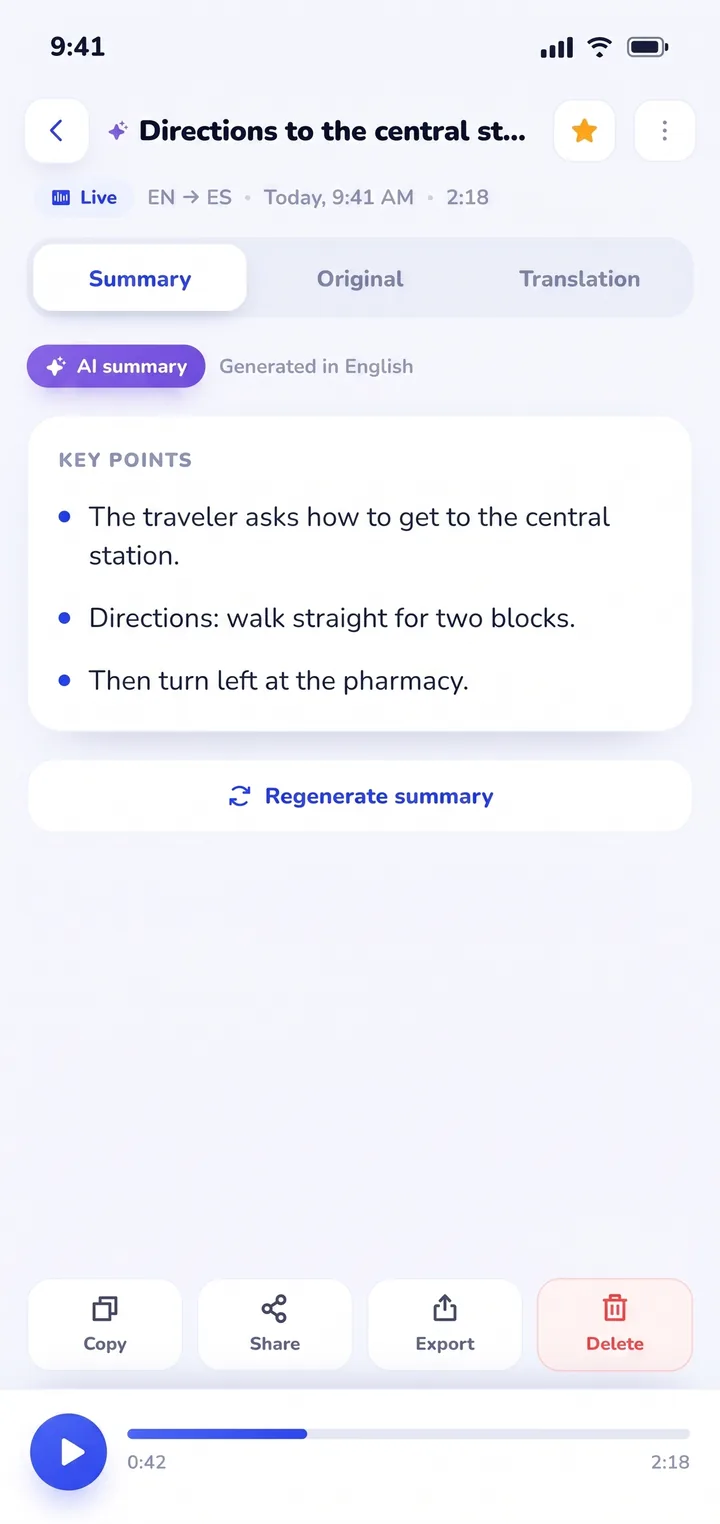
There are clear trade-offs to keep in mind. Clawmium Translate processes speech and camera translations through cloud models to maintain high linguistic accuracy, which means it requires an active Wi-Fi or cellular data connection. It doesn't offer an offline speech mode. It's free to download with a daily allowance for live translation that resets each day, and completely ad-free, with a Pro monthly tier that raises daily usage limits.
For remote underground transit tunnels where cellular reception is unavailable, Google Translate's downloaded offline pack remains the ideal backup tool to keep on your device. To see how other spoken tools operate, read our comparison of apps that translate in real time or explore our technical overview of real-time AI translator apps.


Navigating Deutsche Bahn, ICE trains, and city transit: U-Bahn and S-Bahn
Germany possesses an extensive rail network operated by Deutsche Bahn (DB), but navigating it requires understanding several key operational details:
- Platform announcements (Gleise) and changes (Gleiswechsel): Train platforms in Germany are called Gleise. Platform changes happen frequently due to regional rail congestion. If you hear an announcement starting with "Achtung am Gleis..." or see yellow advisory notices on digital departure displays, check your phone translator to confirm the new platform number.
- High-speed ICE trains vs. regional trains (RE, RB): Intercity Express (ICE) trains connect major German cities at high speeds, while Regional-Express (RE) and Regionalbahn (RB) trains serve suburban towns. If you hold a regional pass (like the Deutschlandticket), you cannot ride ICE, IC, or EC trains without purchasing a separate high-speed ticket.
- Validating paper transit tickets (Entwerter): In many German city networks (such as the Berlin BVG or Munich MVV), purchasing a physical paper ticket from an automated kiosk does not make it valid for travel. You must physically stamp the ticket in the small red or yellow validator boxes (Entwerter) on the platform before stepping onto the train. Boarding with an unstamped ticket carries an immediate 60-euro penalty fine. Digital tickets stored in your phone app do not require stamping.
- Cross-border European travel: If your European travels extend west into France, read our guide to translator apps for France. For southern journeys into the Alps and Mediterranean, explore our guides to translator apps for Italy and translator apps for Spain, or review our guide to translation apps for travel.
Navigating German dining, bakeries, and Christmas markets
Dining in Germany is straightforward and hearty, but certain habits catch international visitors off guard:
- Seating etiquette in beer halls and Gasthäuser: In traditional German restaurants and beer halls, you usually seat yourself rather than waiting at the door for a host (look for signs saying Freie Platzwahl). Sharing large wooden tables with strangers is common practice. Before sitting at an occupied table, it is polite to ask, "Ist hier noch frei?" (Is this seat free?).
- Water preferences: tap vs. sparkling: Tap water is rarely served in German dining spots. If you ask for water, you will almost certainly be brought sparkling water (Sprudelwasser or Wasser mit Kohlensäure). If you want flat mineral water, specifically request stilles Wasser.
- Christmas markets (Weihnachtsmärkte) and the Pfand system: Germany's winter Christmas markets are world-famous. When you purchase a hot mug of spiced wine (Glühwein), hot chocolate, or cider, the vendor charges a cup deposit called a Pfand (typically 3 to 5 euros). When you finish your drink, return the ceramic mug to the stall window to receive your cash deposit back, or keep the decorative mug as a souvenir.
- Cash preferences (nur Barzahlung): While modern stores in major cities accept contactless cards, many traditional bakeries, flea markets, Christmas market stalls, and countryside beer gardens still display signs stating nur Barzahlung (cash only). Always carry euros in cash.
- Food allergies in Germany: If you have dietary restrictions, translate your allergy clearly before ordering. Common German terms include glutenfrei (gluten-free), laktosefrei (lactose-free), and Nussallergie (nut allergy). Showing the written translation on screen ensures the kitchen understands your request.
Sources
- Deutsche Bahn AG, Passenger guidelines, train categories, and delay regulations, checked 10 November 2026.
- Berliner Verkehrsbetriebe (BVG), Berlin public transport ticket validation and network guide, updated September 2025, checked 10 November 2026.
- Münchner Verkehrs- und Tarifverbund (MVV), Munich transit rules and station guide, updated August 2025, checked 10 November 2026.
- Google Help, Translate speech in Google Translate, updated 26 August 2025, checked 10 November 2026.
- Apple Support, Translate text, voice, and conversations on iPhone, updated September 2025, checked 10 November 2026.
- DeepL, DeepL German neural translation documentation, checked 10 November 2026.
Frequently asked questions
What is the best translator app for traveling in Germany?
Most travelers get the best results by carrying Google Translate for offline camera translation of street signs and train platform displays, and Clawmium Translate for live spoken conversations with locals at bakeries, markets, and hotels. DeepL is also great for drafting written messages to property hosts.
Do I need to speak German when visiting Germany?
In major tourist centers like Berlin, Munich, Hamburg, and Frankfurt, many workers in hotels and customer service speak good English. However, in neighborhood bakeries, regional train stations, smaller Bavarian or Black Forest villages, and Christmas market stalls, English is much less common. Carrying a live translation tool helps you navigate transit and converse comfortably.
Can translation apps read German compound words?
Yes. Modern neural translation apps like Clawmium Translate and DeepL recognize compound German words by deconstructing their component roots. When pointing your camera at signs or printed menus, ensure steady lighting so the full word is captured without blur.
Do translation apps work offline on the German U-Bahn?
In underground subway stations and tunnel passages in Berlin, Munich, or Hamburg, cellular mobile reception frequently drops out. To maintain navigation access, download Google Translate's German offline pack before traveling underground.
Try a conversation before your trip to Germany
Free to start. 60+ languages. Put the phone between two people and talk.