For a trip to Spain, download Google Translate's offline Spanish pack before traveling so you can read train departure boards and street signs when cellular reception drops. Use DeepL for drafting polite written messages to hotel hosts or rental agencies. When speaking face to face at tapas bars, markets, or ticket counters, Clawmium Translate divides your screen into two facing halves so each person reads in their language, and automatically saves each session with an AI summary.
An international traveler in Spain encounters three main communication tasks: deciphering printed chalkboard menus, riding regional Renfe trains, and speaking face to face with locals. Google Translate provides free speech translation across Android and iOS, with offline dictionaries that help in underground metro stations. Apple Translate offers on-device neural conversation mode for iPhone users traveling without mobile data. DeepL delivers the most natural Spanish phrasing for written correspondence and accommodation messages.
Clawmium Translate specializes in two-way spoken conversations, placing an inverted display between two people and automatically saving dual-language transcripts with structured AI summaries. Spain has distinct dining hours and regional languages: menus in Barcelona often appear in Catalan first, while tapas ordering moves quickly during peak dinner hours. For rural travel where cellular reception drops without signal, carrying a downloaded Google offline dictionary alongside our online conversation app provides reliable coverage without data worries.
The three translation tasks you face in Spain
Travelers exploring Spain encounter three very different language environments depending on where their route leads:
- Deciphering printed and handwritten Spanish: Traditional tapas taverns in Seville, pintxos bars in San Sebastián, and neighborhood bodegas in Madrid rarely print translated menus. Daily specials are chalked across slate boards (pizarras) mounted high on the wall or written on paper slips behind the bar counter. Museum plaques, historic monuments in Andalusia, and pharmacy receipts also require optical recognition.
- Riding national rail and urban transit: Moving through major railway terminals like Madrid Atocha, Madrid Chamartín, and Barcelona Sants involves luggage security scans, platform boarding gates, and track numbers (vías). In underground Madrid Metro or Barcelona Metro tunnels, mobile signal frequently cuts out, making offline maps and downloaded language packs essential without internet access.
- Face-to-face spoken conversation: Ordering raciones at busy dining bars, asking market vendors about local cheeses, checking into countryside guesthouses (casas rurales), or clarifying train connections with station staff requires quick two-way dialogue.
Spanish dining culture and communication etiquette
Before launching a translation tool in Spain, understanding how Spanish hospitality operates will make your interactions much smoother. Hospitality in Spain is informal, friendly, and lively, but it runs on distinct customs.
The first rule is greeting staff before asking a question. A friendly "¡Buenos días!" (good morning) or "¡Buenas tardes!" (good afternoon/evening) sets a positive tone. Jumping straight into a question without a greeting can come across as abrupt.
The second reality is dining rhythm. Spanish meal times run much later than in northern Europe or North America, with lunch served between 2:00 PM and 4:30 PM.
Dinner rarely begins before 9:00 PM, with locals filling tapas bars well past 11:00 PM. Tapas bars during peak hours are bustling and loud, where shouting questions across the counter is normal as bartenders work at high speed.
Placing a phone down between you and the server to show a clear translated question prevents confusion over dish portions, ingredients, and the bill (la cuenta).
Five translation apps for Spain, compared
These five apps cover the spectrum of travel requirements in Spain, from offline street navigation to live spoken conversations.
| App | Best For | Metro & Offline | Menu Scanning | Face-to-Face Mode | Key Constraint |
|---|---|---|---|---|---|
| Google Translate | Everyday multi-purpose travel | Select Pixel phones only | Live camera & photo translation | Face-to-face split screen | Discards full conversation history |
| Apple Translate | Offline conversation on iPhone | Yes (with downloaded pack) | Text & photo translation | Face to Face split view | Restricted to Apple hardware |
| DeepL | Polite written messages & emails | No (requires internet connection) | Document & photo translation | Single continuous list | Lacks split-screen conversation UI |
| Microsoft Translator | Group chat translation fallback | Yes (downloadable language pack) | Camera photo translation | Split-screen microphone mode | Voice recognition slower on accents |
| Clawmium Translate (ours) | In-person dialogue with AI summaries | No (cellular data or Wi-Fi) | Camera photo translation | Two-way inverted split screen | Requires active internet connection |
Google Translate: the dependable offline baseline
Google Translate is an essential travel utility for any trip to Spain, providing dependable assistance without an internet connection when needed. Its greatest asset for travelers is the depth of its offline Spanish language pack. Before you leave home or from your hotel Wi-Fi, download the Spanish offline dictionary to your phone storage so you're not caught without directions. This allows text and photo translations to work inside deep subway tunnels where cellular reception drops.
Its live translate feature includes a split-screen conversation mode that shows translated text and plays spoken audio as each person speaks. We break down its interface and configuration in our guide to Google Translate's conversation mode.
The trade-off is that offline live speech translation is limited to Google's newer Pixel phones. On standard iPhones and non-Pixel Android devices, live spoken translation requires an active mobile data connection. Google Translate also doesn't save structured summaries or organize multi-turn conversations into reviewable transcripts.
Apple Translate: built-in offline spoken dialogue for iPhone
For travelers carrying an iPhone, Apple Translate comes pre-installed in iOS and runs on Apple's on-device Neural Engine. Travelers can download the Spanish offline language pack in settings, enabling two-way spoken conversation translation without cellular data or Wi-Fi.
Its Face to Face view rotates the top half of the screen 180 degrees so the person standing opposite reads Spanish right side up while you read English. On devices running iOS 26 with Apple Intelligence, Apple also integrates real-time translation into Phone calls and Messages. The constraint is hardware lock-in: it can't be installed on Android devices, and its vocabulary library is smaller than Google's.
DeepL: the standard for natural Spanish phrasing
DeepL has earned an exceptional reputation among linguists for generating natural, idiomatic European Spanish. Spanish grammar features complex verb conjugations, regional idioms, and formal versus informal address (usted versus tú). DeepL captures these nuances with high accuracy.
If you're writing an email to a boutique hotel in Seville, messaging an Airbnb host in Madrid, or translating a long regional festival guide, DeepL produces fluent phrasing. However, DeepL isn't designed as a live conversation tool: it lacks an inverted split-screen interface, and it operates exclusively through cloud servers, requiring an active internet connection.
Microsoft Translator: versatile multi-language fallback
Microsoft Translator offers downloadable offline language packs for Spanish and supports split-screen spoken dialogue. It provides clean text translation and photo scanning capabilities.
While practical for general travel queries, its speech recognition can struggle in noisy environments like packed tapas bars or echoey train station concourses. It also lacks automated post-conversation summarization.
Where Clawmium Translate fits
Clawmium Translate is our app, so evaluate this section with that context in mind. We developed Clawmium Translate specifically to remove the friction of face-to-face conversations between travelers and locals, running on both Android and iPhone.
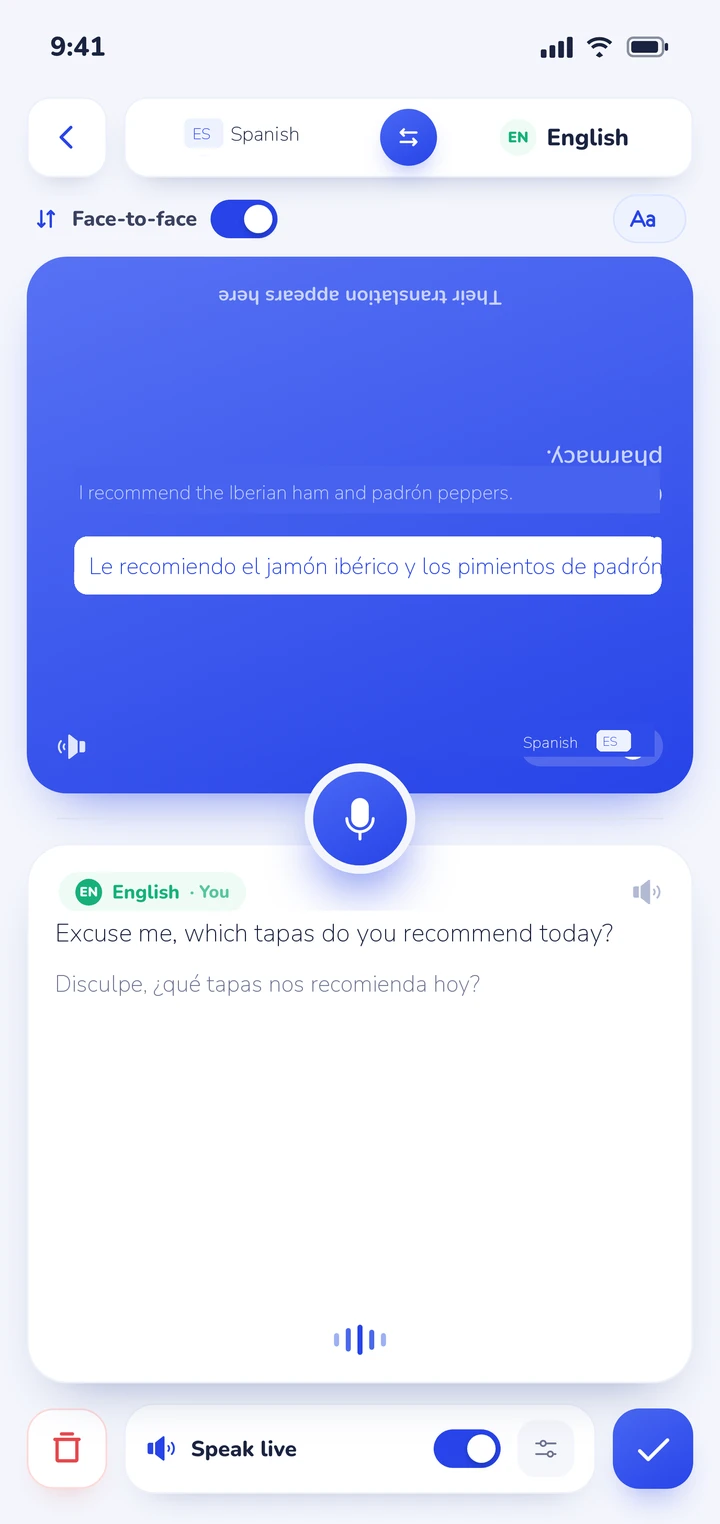
When you start conversation mode, the screen splits into two dedicated viewports. You place your smartphone flat on the counter at a tapas bar in Seville, a ticket window at Madrid Atocha, or a hotel reception desk in Granada. One half faces you, and the other half inverts so the server reads along naturally in Spanish without needing to hold your personal device.
The app detects which of your two selected languages is being spoken automatically, eliminating the clumsy interruption of pushing buttons between every sentence. Translations can also be read aloud through the speaker, with distinct natural voices assigned to each speaker.
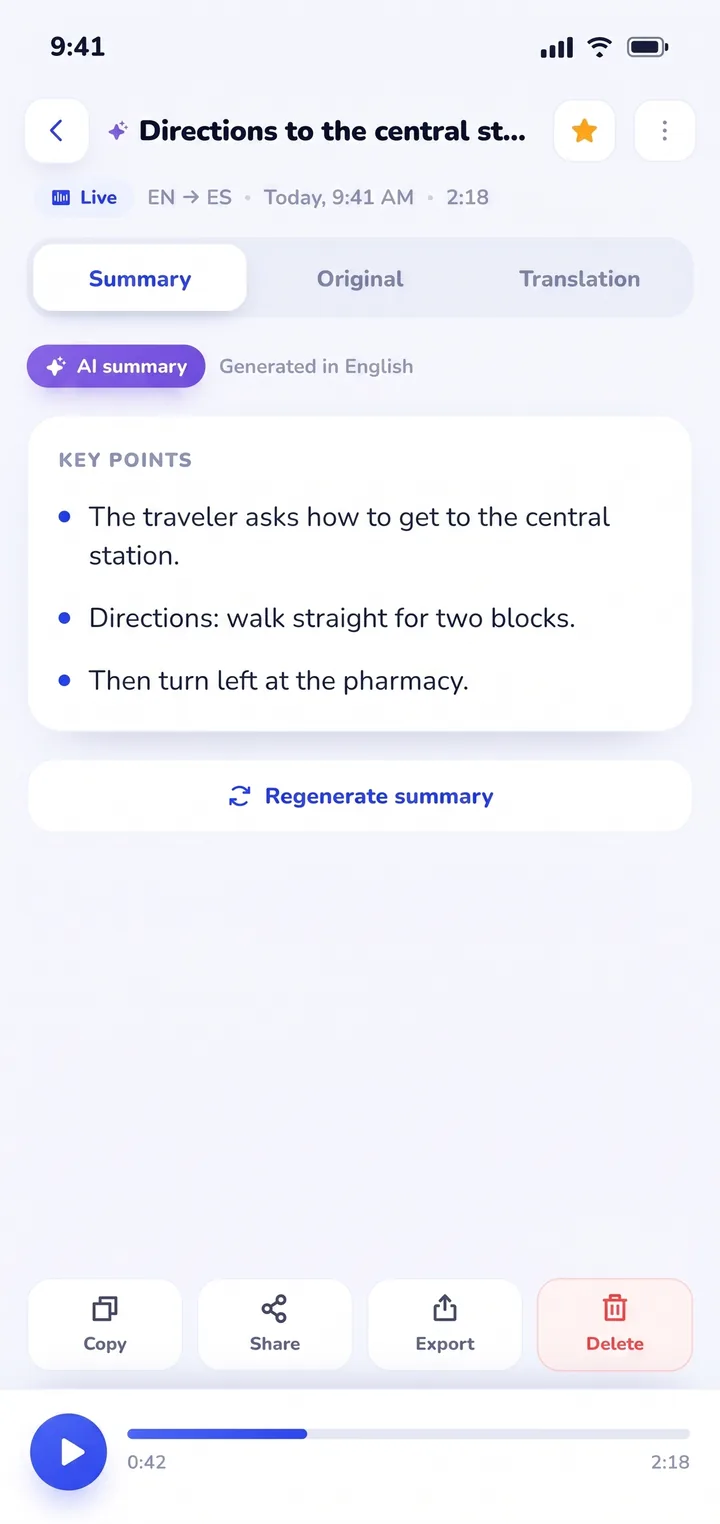
The most practical benefit for travelers in Spain is what happens after your conversation finishes. Every exchange is preserved in History on your device, complete with the dual-language transcript and an automated AI summary of key points. When a friendly bartender recommends three specific tapas spots in Triana or a local explains bus connections to the Alhambra, you don't need to scramble for notes. You open your saved History, review the summarized takeaways, and copy or share the details whenever needed.
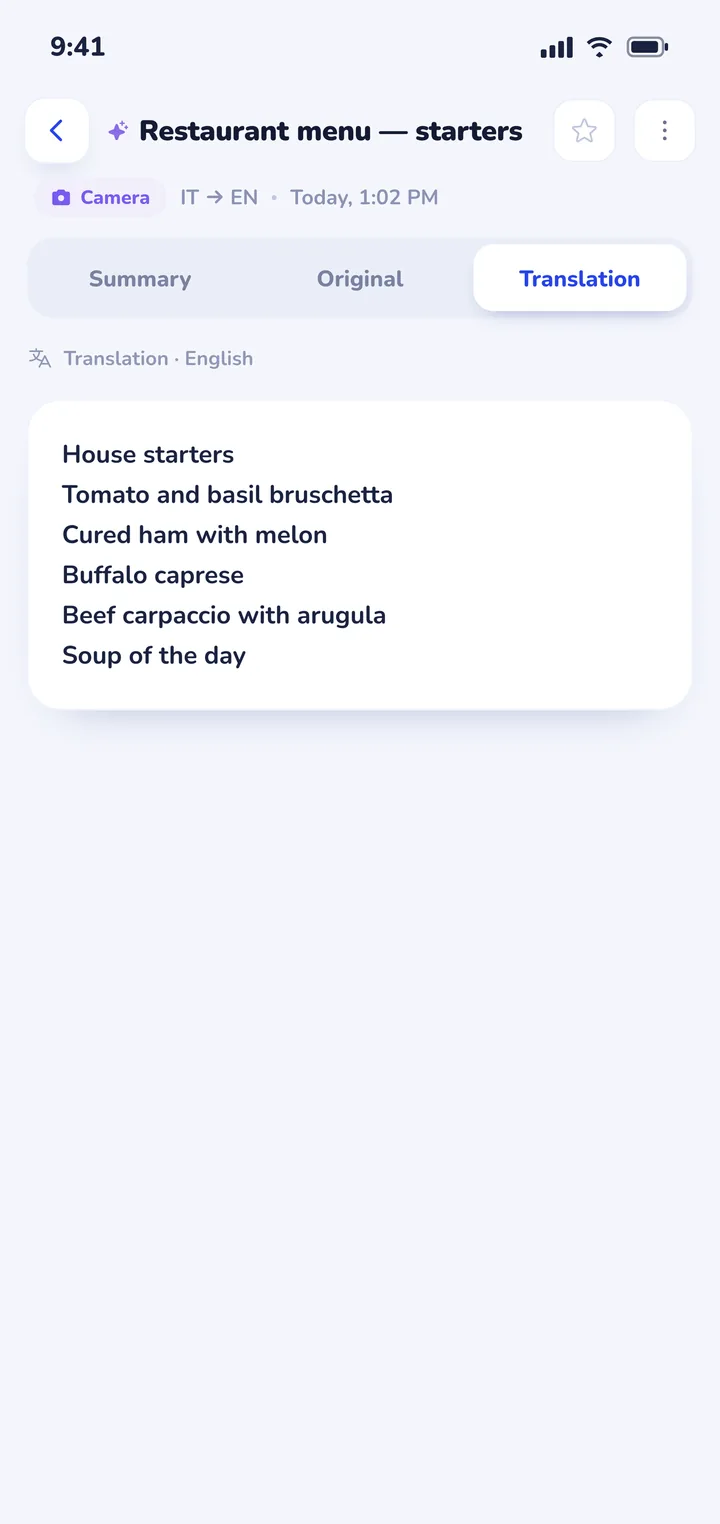
Clawmium Translate also includes a cloud camera translation feature that photographs printed restaurant menus, transit signs, and museum placards, overlaying readable English translations directly over the original image. For practical dining advice, read our guide on how to translate a menu with your camera. The app supports more than 60 languages, including Spanish, English, French, Italian, German, Japanese, Korean, and Arabic.
There are clear trade-offs to keep in mind. Clawmium Translate processes speech and camera translations through cloud models to maintain high linguistic accuracy, which means it requires an active Wi-Fi or cellular data connection. It doesn't offer an offline speech mode. It's free to download with a daily allowance for live translation that resets each day, and completely ad-free, with a Pro monthly tier that raises daily usage limits.
For remote subway passages where cellular reception is unavailable, Google Translate's downloaded offline pack remains the ideal backup tool to keep on your device. To see how spoken translation technology operates in Spanish, read our detailed guide on translating English to Spanish in real time or explore why native speakers talk so rapidly in our linguistic analysis of why Spanish sounds so fast. You can also compare technical options in our overview of real-time AI translator apps.


Navigating Spanish dining: tapas, raciones, and the menú del día
Eating in Spain is one of the world's great culinary experiences, but ordering food involves unique cultural terms:
- Tapas, pintxos, and raciones: A tapa is a small individual snack, often served complimentary with a drink in cities like Granada or León. In the Basque Country, bar counters display skewered bite-sized delicacies called pintxos. A ración is a full sharing platter for the table, while a media ración is a half portion. For two or three travelers, ordering two or three raciones to share is the customary approach.
- The Menú del Día: On weekdays between 1:30 PM and 4:30 PM, almost every traditional Spanish restaurant offers a menú del día (menu of the day). By Spanish law, this fixed-price multi-course meal includes a first course (primer plato), a main course (segundo plato), bread, dessert (postre) or coffee, and a drink (often a full bottle of house wine). It provides the best dining value in Spain.
- Handwritten chalkboard menus (pizarras): In bustling tapas bars, printed menus are rarely handed out. Instead, daily specialties and seasonal catches are written in chalk on wall boards. Keep your smartphone steady and photograph the board squarely to read English descriptions overlaid on the text.
- Food allergies in Spain: If you have dietary restrictions, translate your allergy clearly before ordering. Essential Spanish terms include sin gluten (gluten-free), alergia a los frutos secos (nut allergy), and sin marisco (shellfish-free). Showing the written translation on screen ensures the kitchen understands your request.
Navigating regional languages: Catalan, Basque, and Galician
Spain is a multilingual nation with four co-official languages recognized in their respective autonomous communities:
- Catalan (Català) in Barcelona and Catalonia: In Barcelona, Girona, and the Balearic Islands, official street signs, public transport announcements, and restaurant menus appear primarily in Catalan. For example, "street" is carrer in Catalan rather than calle in Spanish, and "exit" is sortida rather than salida. While locals speak Spanish fluently, camera translation tools that recognize both Spanish and Catalan prevent confusion when reading street signs and menus.
- Basque (Euskara) in San Sebastián and Bilbao: Basque is a non-Indo-European language with entirely unique vocabulary unrelated to Spanish or French. Major transit hubs feature bilingual signage in Basque and Spanish, but small tavern signs and pintxos labels in rural villages often use Basque terms.
- Galician (Galego) in Santiago de Compostela: Spoken across northwestern Spain, Galician shares close historical roots with Portuguese. Road signs and coastal seafood menus frequently use Galician seafood names.
Navigating Renfe trains, AVE high speed, and city transit
Spain's national rail operator, Renfe, runs one of the most efficient high-speed train networks in the world (AVE and Avlo). Keep these transit points in mind:
- Luggage security screening at AVE stations: Unlike regional commuter trains, boarding an AVE high-speed train at Madrid Atocha, Madrid Chamartín, or Barcelona Sants requires passing your luggage through an X-ray scanner before reaching the platform. Arrive at least 30 minutes before departure.
- Platform announcements (vías): Platforms are called vías. At major terminals, track numbers are announced on central departure boards only 15 to 20 minutes before boarding. Look for your train number, coach number (coche), and assigned seat (plaza).
- Commuter networks (Cercanías / Rodalies): In Madrid and Seville, suburban trains are called Cercanías; in Barcelona, they are called Rodalies. If you purchase an AVE ticket, your ticket often includes a free commuter train transfer (Combinado Cercanías) from the airport or city center.
- Cross-border European travel: If your European travels extend north across the Pyrenees into France, check our dedicated guide to translator apps for France for Paris transit tips. For Mediterranean travel, explore our guide to translator apps for Italy, or read our complete guide to translation apps for travel.
Sources
- Renfe Operadora, Passenger guidelines, luggage screening, and AVE travel rules, checked 9 November 2026.
- Madrid Metro (Metro de Madrid), Official tourist travel guide and station network, updated September 2025, checked 9 November 2026.
- Transports Metropolitans de Barcelona (TMB), Getting around Barcelona: Metro and bus network, updated August 2025, checked 9 November 2026.
- Google Help, Translate speech in Google Translate, updated 26 August 2025, checked 9 November 2026.
- Apple Support, Translate text, voice, and conversations on iPhone, updated September 2025, checked 9 November 2026.
- DeepL, DeepL Spanish neural translation documentation, checked 9 November 2026.
Frequently asked questions
What is the best translator app for traveling in Spain?
Most travelers get the best results by carrying Google Translate for offline camera translation of signs and metro boards, and Clawmium Translate for live spoken conversations with servers, shopkeepers, and hotel staff. DeepL is also great for drafting written messages to hosts.
Do I need to speak Spanish when visiting Spain?
In central tourist quarters of Madrid, Barcelona, and Seville, many hotel and restaurant workers speak conversational English. However, in neighborhood tapas taverns, open-air markets, regional train stations, and smaller towns, English is less common. Carrying a live translation tool helps you order confidently and converse naturally.
Can translation apps read handwritten tapas menus?
Yes. You can photograph a chalkboard menu using the camera feature in Clawmium Translate or Google Translate to view English translations overlaid on the board. For dim tapas bars, step closer to the chalkboard and ensure proper lighting rather than using digital zoom.
Do translation apps work offline on the Madrid Metro?
In underground Madrid Metro tunnels and station passages, cellular signals can cut out. To ensure uninterrupted access to street names and directions, download Google Translate's offline Spanish pack before entering the subway network.
Try a conversation before your trip to Spain
Free to start. 60+ languages. Put the phone between two people and talk.