Spanish packs more syllables into each second, but each syllable carries less information than an English or Mandarin syllable. Measured as information per second, languages land in a similar range. Researchers who compared 17 languages found they all carry roughly 39 bits of information per second.
Spanish sounds fast because Spanish speakers produce more syllables per second than English speakers, but each Spanish syllable carries less information. A 2011 study in the journal Language by François Pellegrino, Christophe Coupé and Egidio Marsico of the University of Lyon measured this across seven languages and found that faster syllable rates go with lower information per syllable.
A 2019 follow-up in Science Advances, covering 17 languages, found that all of them carry roughly 39 bits of information per second. Spanish isn't saying more per second; it's spreading the same information over more, smaller pieces, which is why learners hear a blur until they learn common chunks and stressed words.
Do Spanish speakers talk faster?
In syllables per second, yes. In 2011 François Pellegrino, Christophe Coupé and Egidio Marsico, linguists at the University of Lyon, published a study in the journal Language comparing seven languages. They had native speakers read the same short texts aloud and measured how many syllables each speaker produced per second.
| Language | Syllables per second | Information per syllable (Vietnamese = 1) |
|---|---|---|
| Japanese | 7.84 | 0.49 |
| Spanish | 7.82 | 0.63 |
| French | 7.18 | 0.74 |
| Italian | 6.99 | 0.72 |
| English | 6.19 | 0.91 |
| German | 5.97 | 0.79 |
| Mandarin | 5.18 | 0.94 |
Source: Pellegrino, Coupé and Marsico (2011), Table 1. Vietnamese was the reference language and isn't shown.
Spanish and Japanese sit at the top, close to eight syllables a second. English is around six. Mandarin is just over five. So your ears aren't lying: there are more sounds per second coming at you in Spanish.
Why more syllables doesn't mean more meaning
The second column is the interesting one. The researchers also measured how much information each syllable carries, using Vietnamese as the reference point. A Spanish syllable carries about 0.63 units on that scale. An English syllable carries about 0.91, and a Mandarin syllable 0.94.
One reason is the shape of the syllables themselves. Spanish has relatively few syllable types, and many are a simple consonant plus a vowel: "pa", "ra", "to". English allows heavy clusters such as "strengths", where one syllable holds many sounds. Mandarin uses tones, so the same consonant and vowel can mean different things depending on pitch, which lets each syllable carry more.
Small, light syllables can be produced quickly. Heavy ones take longer. Each language trades speed against density, and the trade works out to a similar result.
One sentence in three languages
The study's own test text makes this concrete. One of its sentences, in three of the languages:
- English: "Last night I opened the front door to let the cat out." That's 13 syllables.
- Spanish: "Anoche, abrí la puerta del jardín para sacar al gato." That's 18 syllables.
- Mandarin: 昨晚我打开前门放猫出去. That's 11 syllables, one per character.
Divide each count by that language's average rate from the table and you get a rough speaking time: 13 ÷ 6.19 is about 2.1 seconds for English, 18 ÷ 7.82 is about 2.3 seconds for Spanish, and 11 ÷ 5.18 is about 2.1 seconds for Mandarin. The Spanish speaker fires out five more syllables than the English speaker and finishes at almost the same moment. This is an illustration using averages, not a measurement of one recording.
Thirty-nine bits per second
In 2019 Coupé, Pellegrino and colleagues returned to the question with a larger study in Science Advances, covering 17 languages from nine language families, including Basque, Cantonese, Finnish, Korean, Thai, Turkish and Vietnamese. They again found wide differences in speech rate and in information per syllable, and again found the two pull against each other. Multiplied together, the languages clustered around an information rate of about 39 bits per second.
The researchers' interpretation is that human speech may settle around a rate the brain processes comfortably, whatever the language. Fast languages and slow languages arrive at the same place by different routes.
The 2011 study didn't find perfect equality. English came out somewhat higher than Spanish, and Japanese lower. The 2019 study, with more languages and speakers, is the one that found the convergence. "Roughly the same" is the honest summary.
What this means for learners
If Spanish feels too fast, it isn't a sign that you're bad at it. You are receiving more, smaller pieces per second than you're used to, and your brain hasn't yet learned to group them. A few things help.
- Listen for stressed syllables and key words rather than every sound. The meaning lives in the content words.
- Learn common chunks as single units: "¿qué tal?", "por favor", "a ver". Spoken Spanish joins words together, so "¿qué es esto?" often sounds like one word.
- Read along when you can. Subtitles let your eyes catch the pieces your ears missed, which is why watching Spanish shows with Spanish subtitles is a common recommendation.
- Learn the traps that aren't about speed: tú or usted, words that differ between Spain and Latin America, and false friends. Our guide to Spanish translator apps has tables of each.
- Ask people to slow down. "¿Podría hablar un poco más despacio?" is one of the most useful sentences you can learn.
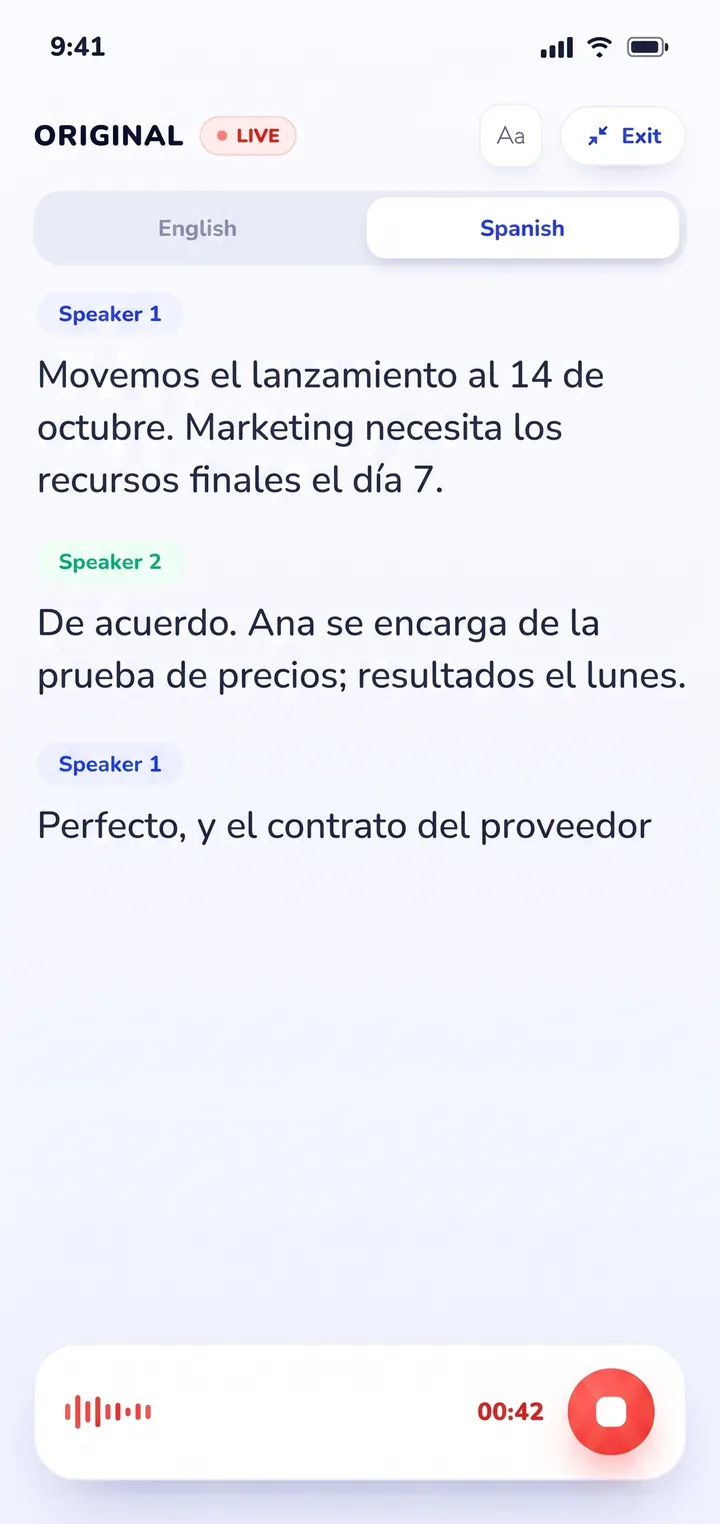
Reading along is also how live translation apps help in a real conversation: the words appear on screen as they're spoken, so a fast speaker doesn't have to repeat themselves. Our guide to using a conversation translator face to face covers how to set one up, and our list of apps that translate in real time compares the main ones.
Where Clawmium Translate fits
Clawmium Translate is our app, so weigh this section with that in mind. Its live mode shows the Spanish transcript and the English translation as people speak, so you can read along with a fast speaker. Conversation mode splits the screen so each person reads their own language, and each session is saved with the transcript in both languages and an AI summary. It runs on Android and iPhone, needs an internet connection, and is free to download with a daily allowance and no ads.
Sources
- Pellegrino, F., Coupé, C. and Marsico, E. (2011). "A cross-language perspective on speech information rate." Language, 87(3), 539–558.
- Coupé, C., Oh, Y. M., Dediu, D. and Pellegrino, F. (2019). "Different languages, similar encoding efficiency: Comparable information rates across the human communicative niche." Science Advances, 5(9).
Frequently asked questions
Is Spanish the fastest spoken language?
In the 2011 study, Japanese (7.84 syllables per second) and Spanish (7.82) were the fastest of the seven languages measured. Speed varies a lot between individual speakers, so these are averages.
Do fast languages carry more information?
No. Faster languages tend to carry less information per syllable. Across 17 languages, researchers found information rates clustered around 39 bits per second.
Why does Spanish sound like one long word?
Spanish has a high syllable rate and joins words together in speech, so the boundaries between words are hard to hear until your ear learns common chunks.
How can I understand fast Spanish?
Listen for stressed words rather than every syllable, learn common phrases as single units, read along with subtitles, and ask people to speak more slowly when you need it.
Try a live conversation
Free to start. 60+ languages. Each person reads their own language.